Can No Longer Download Yahoo Stock Prices 1004 Error
Learn how to summate the exponential moving average in Excel and VBA, and become a free web-connected spreadsheet.
The spreadsheet retrieves stock data from Yahoo Finance, calculates EMA (over your chosen time window) and plots the results.
The download link is at the bottom. The VBA can be viewed and edited; it'due south completely gratis.
But first disover why EMA is important to technical traders and market analysts.

Historical stock cost charts are often polluted with a lot of high-frequency noise. This oft obscures major trends. Moving averages help smooth out these pocket-size fluctuations, giving you greater insight into the overall market direction.
The exponential moving average places greater importance on more contempo information. The larger the time period, the lower the importance of the most contempo information.
EMA is defined by this equation.
 where P is the price and T is the time flow. Substantially, the EMA today is the sum of
- today's price (multiplied by a weight)
- and yesterday'south EMA (multiplied past 1-weight)
Y'all need to kickstart the EMA calculation with an initial EMA (EMA0). This is ordinarily a simple moving average of length T.
The nautical chart above, for case, gives the EMA of Microsoft between 1st Jan 2013 and 14th January 2014.
Technical traders often employ the cross-over of two moving averages – one with a curt timescale and another with a long timescale – to generate buy/sell signals. Often 12- and 26-mean solar day moving averages are used.
When the shorter moving average rises in a higher place the longer moving boilerplate, the marketplace is trending updwards; this is a buy bespeak. Withal, when the shorter moving averages falls below the long moving average, the market is falling; this is a sell signal.
Let's get-go learn how to calculate EMA using worksheet functions. After that we'll find how to use VBA to compute EMA (and automatically plot charts!)
Calculate EMA in Excel with Worksheet Functions
Step 1. Permit's say that we want to calculate the 12-day EMA of Exxon Mobil's stock price. We offset need to become historic stock prices – y'all tin can do that with this majority stock quote downloader.
Step 2. Calculate the simple average of the beginning 12 prices with Excel's Average() function. In the screengrab beneath, in jail cell C16 nosotros have the formula =AVERAGE(B5:B16) where B5:B16 contains the beginning 12 close prices

Pace iii. Merely below the prison cell used in Step 2, enter the EMA formula to a higher place
 Step iv. Copy the formula entered in Step 3 downwards to calculate the EMA of the entire fix of stock prices.
 There you have it! You've succesfully calculated an of import technical indicator, EMA, in a spreadsheet.
Summate EMA with VBA
Now let'due south mechanize the calculations with VBA, including the automated creation of plots. I won't show you the total VBA here (it's available in the spreadsheet below), but nosotros'll discuss the most critical code.
Step 1. Download historical stock quotes for your ticker from Yahoo Finance (using CSV files), and load them into Excel or use the VBA in this spreadsheet to get historical quotes straight into Excel. Your information may look something like this:
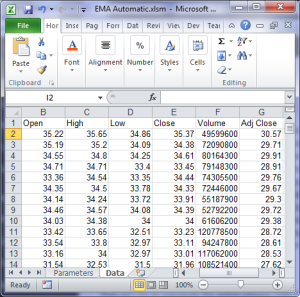
Step ii. This is where we need to excercise a few braincells – we demand to implement the EMA equation in VBA. We can use R1C1 style to programatically enter formulae into individual cells. Examine the code snippet below.
one 2 | Sheets("Data").Range("h" & EMAWindow + 1) = "=average(R[-" & EMAWindow - 1 & "]C[-3]:RC[-3])" Sheets("Data").Range("h" & EMAWindow + 2 & ":h" & numRows).FormulaR1C1 = "=R[0]C[-3]*(2/(EMAWindow + 1)) + R[-1]C[0] * (1-(2/(EMAWindow+1)))" |
Sheets("Data").Range("h" & EMAWindow + 1) = "=average(R[-" & EMAWindow - 1 & "]C[-iii]:RC[-iii])" Sheets("Information").Range("h" & EMAWindow + 2 & ":h" & numRows).FormulaR1C1 = "=R[0]C[-3]*(ii/(EMAWindow + 1)) + R[-1]C[0] * (i-(two/(EMAWindow+one)))"
- EMAWindow is a variable that equals the desired fourth dimension window
- numRows is the total number of data points + ane (the "+ 1" is because we're bold that the actual stock data starts on row 2)
- the EMA is calculated in column h
Assuming that EMAWindow = v and numrows = 100 (that is, there are 99 data points)
- the get-go line places a formula in prison cell h6 that calculates the arithmetic average of the first 5 historical information points

- The 2nd line places formulas in cells h7:h100 that calculates the EMA of the remaining 95 data points

Footstep three
This VBA function creates a plot of the close price and EMA.
i 2 3 4 5 half dozen seven 8 nine 10 xi 12 13 14 15 xvi 17 18 nineteen 20 21 22 23 24 25 26 27 28 29 xxx 31 | Fix EMAChart = ActiveSheet.ChartObjects.Add(Left:=Range("a12").Left, Width:=500, Top:=Range("a12").Pinnacle, Height:=300) With EMAChart.Chart .Parent.Proper noun = "EMA Chart" With .SeriesCollection.NewSeries .ChartType = xlLine .Values = Sheets("data").Range("e2:eastward" & numRows) .XValues = Sheets("data").Range("a2:a" & numRows) .Format.Line.Weight = 1 .Proper noun = "Price" End With With .SeriesCollection.NewSeries .ChartType = xlLine .AxisGroup = xlPrimary .Values = Sheets("data").Range("h2:h" & numRows) .Name = "EMA" .Border.ColorIndex = i .Format.Line.Weight = ane Terminate With .Axes(xlValue, xlPrimary).HasTitle = True .Axes(xlValue, xlPrimary).AxisTitle.Characters.Text = "Toll" .Axes(xlValue, xlPrimary).MaximumScale = WorksheetFunction.Max(Sheets("Data").Range("e2:e" & numRows)) .Axes(xlValue, xlPrimary).MinimumScale = Int(WorksheetFunction.Min(Sheets("Data").Range("e2:e" & numRows))) .Legend.Position = xlLegendPositionRight .SetElement (msoElementChartTitleAboveChart) .ChartTitle.Text = "Close Cost & " & EMAWindow & "-Day EMA" Terminate With |
Prepare EMAChart = ActiveSheet.ChartObjects.Add(Left:=Range("a12").Left, Width:=500, Top:=Range("a12").Top, Height:=300) With EMAChart.Chart .Parent.Name = "EMA Nautical chart" With .SeriesCollection.NewSeries .ChartType = xlLine .Values = Sheets("data").Range("e2:eastward" & numRows) .XValues = Sheets("information").Range("a2:a" & numRows) .Format.Line.Weight = 1 .Proper name = "Price" Stop With With .SeriesCollection.NewSeries .ChartType = xlLine .AxisGroup = xlPrimary .Values = Sheets("data").Range("h2:h" & numRows) .Name = "EMA" .Border.ColorIndex = 1 .Format.Line.Weight = 1 End With .Axes(xlValue, xlPrimary).HasTitle = True .Axes(xlValue, xlPrimary).AxisTitle.Characters.Text = "Price" .Axes(xlValue, xlPrimary).MaximumScale = WorksheetFunction.Max(Sheets("Data").Range("e2:e" & numRows)) .Axes(xlValue, xlPrimary).MinimumScale = Int(WorksheetFunction.Min(Sheets("Data").Range("e2:e" & numRows))) .Legend.Position = xlLegendPositionRight .SetElement (msoElementChartTitleAboveChart) .ChartTitle.Text = "Close Cost & " & EMAWindow & "-Day EMA" Finish With
Become this spreadsheet for the total working implementation of the EMA figurer with automated download of historical data.
Download Excel Spreadsheet to Calculate EMA with VBA
DOWNLOAD HERE
Posted by: joyceweentrat.blogspot.com


0 Comments