Various Artists 1968 The Beat Goes On Digital Download
| The Monkees | |
|---|---|
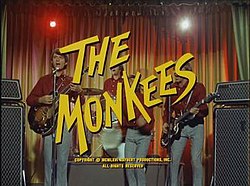 Flavour Ane title card | |
| Genre | Sitcom |
| Created by |
|
| Adult by |
|
| Starring |
|
| Theme music composer |
|
| Opening theme | "(Theme From) The Monkees" |
| Ending theme | "For Pete's Sake" (second season but) |
| Composer | Stu Phillips (background music) |
| Country of origin | United States |
| Original language | English language |
| No. of seasons | 2 |
| No. of episodes | 58 (listing of episodes) |
| Product | |
| Executive producers |
|
| Producers |
|
| Cinematography |
|
| Editor | Mike Pozen (and others) |
| Photographic camera setup | Single-photographic camera |
| Running time | 25 minutes |
| Production companies |
|
| Distributor | Sony Pictures Television |
| Release | |
| Original network | NBC |
| Moving-picture show format | NTSC |
| Sound format | Monaural |
| Original release | September 12, 1966 (1966-09-12) – March 25, 1968 (1968-03-25) |
| Chronology | |
| Followed by |
|
| Related shows | New Monkees |
| External links | |
| Website | |
The Monkees is an American situation comedy series that first aired on NBC for ii seasons, from September 12, 1966, to March 25, 1968. The series follows the adventures of four young men (The Monkees) trying to make a name for themselves as a rock 'due north roll band. The show introduced a number of innovative new-wave film techniques to series tv and won two Emmy Awards in 1967, including Outstanding Comedy Series. The program ended in 1968 at the stop of its 2nd flavor and has received a long afterlife through Saturday morning repeats (CBS and ABC) and syndication, likewise equally overseas broadcasts.
It later enjoyed a 1980s revival, subsequently MTV aired reruns of the program in 1986. It aired on Lord's day afternoons on MeTV outset on February 24, 2019, three days after the expiry of cast member Peter Tork catastrophe Apr 26, 2020. The network aired four episodes on Dec 12, 2021 equally a tribute to Michael Nesmith, who died on December x, 2021, followed by a 'Weekend Binge' December 11th and twelfth.
Overview [edit]
The series centered on the adventures of the Monkees, a struggling rock ring from Los Angeles, California consisting of Micky, Davy, Michael, and Peter. The comic elements of the storyline were provided by the strange and often surreal encounters that the band would have while searching for their big break.
Production [edit]
Formulation and casting [edit]
In the early on 1960s, aspiring filmmakers Bob Rafelson and Bert Schneider had formed Raybert Productions and were trying to go a foot in the door in Hollywood. They were inspired past the Beatles' movie A Hard Twenty-four hour period's Nighttime and decided to develop a television series almost a fictional rock and roll group.[1] Raybert sold the series thought to Screen Gems in Apr 1965,[2] and Paul Mazursky and Larry Tucker completed a pilot script by August entitled "The Monkeys".[3] Rafelson has said that he had the idea for a TV serial about a music group as early as 1960, but had a hard time interesting anyone in it until 1965, by which time rock and roll music was firmly entrenched in pop culture.
Trade publications Daily Diversity and The Hollywood Reporter ran an advert on September 8, 1965, seeking "Folk & Curlicue Musicians-Singers for acting roles in new Idiot box series." As many equally 400 hopefuls showed upward to be considered as 1 of "iv insane boys."[4] Fourteen actors from the audition pool were brought back for screen tests[5] and Raybert chose their final four after audition enquiry.
Micky Dolenz, son of screen actor George Dolenz, had prior screen feel under the name "Mickey Braddock" equally the 10-yr-sometime star of the Circus Male child series in the 1950s. He was actively auditioning for pilots at the time and was told virtually the Raybert project past his agent.[4]
Englishman Davy Jones was a former jockey who had accomplished some initial success on the musical stage, appearing with the bandage of Oliver! on The Ed Sullivan Show the night of the Beatles' live American debut. He was appearing in Columbia Pictures productions and recording for the Colpix tape label and had been identified in accelerate as a potential star for the series.[3]
Texan Michael Nesmith'south mother Bette Nesmith Graham had invented a correction fluid and founded the company that became Liquid Newspaper. He had served a brief stint in the U.Due south. Air Force and had also recorded for Colpix under the proper noun "Michael Blessing." He was the just one of The Monkees who had come for the audition based on seeing the trade magazine advert. He showed upwards to the audience with his laundry[iv] and impressed Rafelson and Schneider with his laid-back fashion and droll sense of humor. He likewise wore a woollen hat to keep his hair out of his eyes when he rode his motorcycle,[6] leading to early promotional materials which nicknamed him "Wool Chapeau." The hat remained part of Nesmith's wardrobe, but the name was dropped after the pilot.[6]
Peter Tork was recommended to Rafelson and Schneider by friend Stephen Stills at his audition.[four] Tork was a skilled multi-instrumentalist who had performed at various Greenwich Village folk clubs before moving west, where he worked as a busboy.[4]
Development [edit]
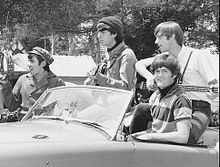
The Monkees in the spring of 1966, presently later on production for the first flavour had begun
Rafelson and Schneider wanted the style of the series to reverberate avant garde film techniques — such equally improvisation, quick cuts, leap cuts, breaking the fourth wall, and free-flowing, loose narratives — so being pioneered by European motion-picture show directors. Each episode would contain at to the lowest degree one musical "romp" which might have nothing to do with the storyline. In retrospect, these vignettes now look very much like music videos: curt, self-contained films of songs whose mode echoed the Beatles' recent ventures into promotional films for their singles. Rafelson and Schneider also believed strongly in the program's power to entreatment to immature people, intentionally framing the kids as heroes and the adults as heavies.[7]
Rafelson and Schneider hired novice managing director James Frawley to teach the 4 actors improvisational one-act. Each of the 4 was given a different personality to portray: Dolenz the funny one, Nesmith the smart and serious one, Tork the naive one, and Jones the cute one. Their characters were loosely based on their existent selves, with the exception of Tork, who was actually a quiet intellectual. The character types also had much in common with the respective personalities of the Beatles, with Dolenz representing the madcap attitude of John Lennon, Nesmith affecting the deadpan seriousness of George Harrison, Tork depicting the odd-man-out quality of Ringo Starr, and Jones carrying the pin-upwards appeal of Paul McCartney.
A airplane pilot episode was shot in San Diego and Los Angeles on a shoestring budget — in many scenes, the Monkees wore their own wearing apparel. Initial audience tests (which were just and so being pioneered) produced very low responses. Rafelson then re-edited the pilot and included some of the screen tests to ameliorate introduce the band members to viewers. (Dolenz was credited in this pilot as "Micky Braddock.") The re-cut pilot tested so well that NBC placed an order for two seasons of episodes (the edited pilot was broadcast November 14, 1966, as the tenth episode of the beginning season, with Dolenz credited under his real concluding name, equally for all other episodes).
Filming [edit]
The Monkees debuted September 12, 1966, on the NBC television network. The serial was sponsored on alternating weeks by Kellogg's Cereals and Yardley of London.
The serial was filmed past Screen Gems, and many of the same sets and props from The Iii Stooges brusque films made by the studio were used on The Monkees: A pair of pajamas with a bunny design on the forepart that had been worn by Curly Howard in shorts such as Cactus Makes Perfect and In the Sweet Pie and Pie were the aforementioned ones worn by Peter Tork in various episodes, such as "A Coffin Too Frequent" and "Monkee See, Monkee Die".[8]
Due to the young men routinely wandering off set and being hard to find when needed for filming, any of the 4 Monkees who was non needed in front of the cameras was sequestered in a repurposed meat locker.[9] In the DVD commentary, Tork noted that this had the added do good of concealing any marijuana use that might be going on, although he admitted that he was the sole "serious 'caput'" of the 4 of them (in the 1980s, Tork gave upward booze and marijuana utilize and volunteered time to aid people recovering from alcoholism). In a studio outtake included in the 1990s re-release of Headquarters, Nesmith quips, before launching into "Nine Times Blue": "Just difference between me and Peter is I'm merely stone legal."[10]
Due to the loosely scripted nature of the series, some episodes would come in too short for air. The producers decided to make full fourth dimension with various "extras", including the Monkees' original screen tests and aboveboard interviews with the grouping (conducted by Rafelson off-camera); these interviews ordinarily lasted one minute, hence the frequent joke, "Nosotros're a minute brusque as usual," though the episode "Discover the Monkees" featured a three-minute epilogue interview (in which the Monkees gave their opinions on the then-recently occurred Sunset Strip curfew riots). Although the early episodes contained a laugh runway, which was standard exercise at the time, the prove eventually did non add one and half of the episodes from Flavor 2 had no canned laughter.
Music [edit]
The theme vocal to The Monkees, "(Theme From) The Monkees" (released every bit the unmarried in some countries in 1967), is 1 of the group'due south most well known songs. The line "We're the young generation and nosotros've got somethin' to say" reflected the new youth counterculture and their desire to give their own opinions on world events and choosing how to live their own lives instead of constant by the traditions and beliefs of their elders.[ citation needed ]
For the second season, the show used a version of the song "For Pete'south Sake" as the closing theme, which appeared on the Monkees' album Headquarters.
The Monkees' "pad" [edit]
The Monkees resided in a ii-story beach business firm. The address varied in different episodes.
- 1334 Beechwood in "Your Friendly Neighborhood Kidnappers"
- 1424 ???, Malibu, California, in "Also Many Girls"
- 1438 Due north Beechwood co-ordinate to Davy in "The Case of the Missing Monkee"
- 1334 Due north Beechwood Drive, Hollywood, California, co-ordinate to the telegram in Caput
The address 1334 North Beechwood Drive, Hollywood, California, was oftentimes given in sixteen magazine as an address to contact Screen Gems and/or The Monkees. The front of the first floor was a combination of the living room, dining room and kitchen. In the dorsum, overlooking the Pacific Body of water, was an apse formed past massive floor-to-ceiling bay windows, where the Monkees kept their instruments and rehearsed songs. The walls were covered with diverse kitschy signs and posters, such as the "Coin IS THE ROOT OF ALL EVIL" sign virtually the kitchen, the "SCRUB Up" sign above the kitchen sink, and the "IN Case OF FIRE, RUN" sign with an arrow pointing to an old-fashioned fire extinguisher near the front end door. At that place were too two doors in the kitchen area; one led to a bath, the other to Davy and Peter's bedroom. The 2d flooring (via spiral staircase near the front door) only consisted of Micky and Mike's bedroom. By the second flavor, the upstairs bedroom was occupied past all 4 Monkees. Also "residing" with the Monkees was Mr. Schneider, a mannequin who dispensed philosophical advice with the pull of his cord. Mr. Schneider was named later the show's co-producer Bert Schneider and was mostly voiced by master director James Frawley. During Season I, the boys also had to argue with their bad-tempered landlord Mr. Babbit, who was always yelling at them about diverse infractions that he thought they were responsible for or threatening to throw them out for not paying their hire.
Monkeemobile [edit]
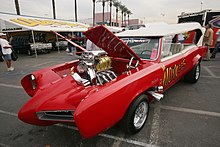
The Monkeemobile was a modified Pontiac GTO designed and built by designer Dean Jeffries. The car featured a tilted forward split two-piece windshield, a touring motorcar T-bucket-type convertible tiptop, modified rear quarter panels and front fenders, exaggerated tail lamps, a set of 4 bucket seats with an actress third row bench where the rear deck should take been and a parachute. The front grille sported the GTO emblem.[xi] [12]
Awards and nominations [edit]
The Monkees won ii Emmy Awards in 1967: Outstanding Comedy Serial and Outstanding Directorial Accomplishment in One-act (James Frawley, for the episode "Regal Affluent"). Frawley was nominated for the same award the post-obit season (for the episode "The Devil and Peter Tork"). Its win for One-act Series was considered somewhat of an upset, as it bested long-time favorites The Andy Griffith Show, Bewitched, Get Smart and Hogan'southward Heroes.
Decline and cancellation [edit]
For its showtime flavour (1966–1967), the series fared well in the television ratings bolstered past several striking records by the band. The Monkees became a huge pop culture sensation. Even so, the public did not realize the bear witness and the band were just a regularly produced television serial and the Monkees characters did not write or perform their ain studio music except to provide the vocals. The but exception were their live performances. When the truth became known, there was considerable backfire from many fans and music critics. Liner notes for a 2006 re-release of More of the Monkees also noted that the album sales had consistently outperformed the TV show's Nielsen ratings; more were listening to the Monkees than watching The Monkees on TV. The West Declension American recording industry had many session musicians under contract performing for many musical acts, such equally the Wrecking Crew, that recorded for the Monkees and many other music groups of this era, so this was zip new.
Nonetheless, NBC responded to the criticism and internal tensions by retooling the evidence in its 2d flavour with the Monkees at present writing and performing much of their ain music that was much less pop-oriented. Moreover, Don Kirshner, the producer for the Monkees for their start flavour and responsible for their first smash hits, was terminated by Colgems Records, resulting in a much less bubblegum rock audio for the band. In add-on, the first flavor'south clean cut looks were replaced by more hippy-looking attire. Past 1968, both NBC and the ring felt the series had run its course, as even with the changes, the formulaic premises of each episode were offset to repeat themselves. The serial was cancelled in 1968.
The series finale, Dolenz'due south original story "The Frodis Antic," was written equally a satire of the industry and a parting shot thereto: an evil middle resembling the CBS logo is hypnotizing television viewers everywhere and the Monkees trace information technology to an alien found being manipulated by a villain seeking world domination. When the plant emits fume, it pacifies the villain, the significant of which Dolenz stated he would leave to the imagination of the viewer. Tim Buckley, equally a special guest, closes out the series with his "Song to the Siren."[13]
Had the series been renewed for a third flavor, the Monkees had planned on abandoning the sitcom format and retooling the serial. Ideas that had been bandied about included a music-centered live show, a variety testify or a sketch one-act series.[13]
In 1968, The Monkees starred in their own motility film titled Head. Elements of the series were included in the film. The flick did poorly at the box office and criticism was mostly mixed.
Syndication [edit]
The Monkees enjoyed a resurgence on Saturday morn/afternoon tv set on CBS from September 1969 to September 1972 (sponsored by General Foods' Kool-Help) and on ABC from September 1972 to August 1973. To coincide with the releases of The Monkees Present and Changes albums during this time menses, many episodes replaced the older songs with tracks from these recent releases[14] (this strategy was also employed during the summer of 1967, when many of the first-season episodes had their songs from the first ii albums replaced with songs from the then-current unmarried and from the 3rd anthology Headquarters).[15]
The 58 episodes were then sold to local markets for syndication in September 1975, where they typically appeared on independent television stations on weekday afternoons (the opening championship sequence seen in the syndication package for all 58 episodes is from the second season of the original run).
A 2d, massive resurgence occurred when a Monkees marathon aired on February 23, 1986, on MTV. Inside months, the 58 episodes were airing regularly throughout the United States on local stations (in edited grade), Nickelodeon/MTV (uncut), equally well as Canada on MuchMusic. Dolenz, Tork and Jones, already reunited for a "20th Anniversary Bout", went from playing small clubs to stadiums as the series defenseless on and the bout drew critical praise. The popularity led Columbia Pictures to create a "reboot" version of the franchise in 1987, New Monkees, but information technology flopped and was cancelled after a half season.[xvi]
The series has aired edited versions on Antenna Boob tube, a digital subchannel network that broadcasts classic programming from the 1950s-1990s era. IFC besides picked up the series for reruns in spring 2015. FETV, a cable and satellite network, began airing the series in December 2017. In 2018, Canadian superstation CHCH in Hamilton, Ontario began conveying the series; the station is viewable over-the-air in areas of New York State and Michigan that edge Ontario.
From March three, 2019, to Apr 26, 2020, restored episodes of The Monkees aired on MeTV on Sundays at v p.thou. and 5:30 p.1000., following an overwhelming response to Peter Tork's expiry after MeTV aired two episodes on Feb 24, 2019, as a tribute to the tardily Monkee.[17]
Rhino Records at present serves as the underlying rights holder for this series, equally they acquired the Monkees' music catalog, Tv set series and official logo from Raybert and Columbia Pictures in 1994. Sony Pictures Television set, which has owned Columbia Pictures since 1989, remains the boob tube distributor for syndication.
Legacy [edit]
The TV prove Miami 7, the debut of the British 1990s pop ring S Club 7, had a very similar premise. It was the second time that a manufactured band had their own Telly show on American telly. Likewise, the Nickelodeon sitcom Big Fourth dimension Rush followed the same basic format and premise; the producers of that show acknowledged The Monkees as their master inspiration.[18]
Dolenz said in a 2007 interview on the Roe Conn radio program that, while inspiration did come from the Beatles, the band's prototype was not meant to be a rip-off of them. He said that the Beatles were always depicted every bit superstars with legions of fans, whereas the Monkees were always depicted every bit unsigned and struggling to make a buck. This is reflected numerous times throughout the serial, such as in the airplane pilot, where Mike Nesmith is seen throwing darts at a Beatles poster and in the episode "Find the Monkees (The Audition)" where the Monkees struggle to encounter a famous television receiver producer who is looking for a stone act for employ in commercial advertisements; in the episode "I Was a 99-Pound Weakling", Micky is tricked into signing onto a bogus weight-training program, simply objects by noting, "Where am I gonna go that kind of money? I'm an unemployed drummer." Also in a screen examination, a Monkee asks what the Beatles accept that they do not have. They sing "Thirteen million dollars!" Also, the last episode of the series, "The Frodis Caper," opens with the repetitive strains of the chorus of the Beatles' "Good Morn, Good Morning" from Sgt. Pepper'south Lonely Hearts Club Band.
When commenting on the death of Davy Jones on February 29, 2012, Fourth dimension magazine contributor James Poniewozik praised the show: "Even if the show never meant to exist more entertainment and a hit-single generator, we shouldn't sell The Monkees short. Information technology was far better TV than it had to exist; during an era of formulaic domestic sitcoms and wacky comedies, information technology was a stylistically ambitious show, with a distinctive visual fashion, absurdist humour and unusual story construction. Whatever Jones and The Monkees were meant to exist, they became creative artists in their own right, and Jones' chipper Brit-pop presence was a large reason they were able to produce work that was commercial, wholesome and yet impressively weird."[nineteen]
Home video [edit]
Six two-episode VHS volumes of the television series were distributed past Musicvision/RCA/Columbia Pictures Home Video betwixt July 15, 1986, and June 25, 1987, taking advantage of the group'due south 20th anniversary.
On October 17, 1995, with the Monkees' 30th anniversary looming, Rhino Dwelling house Video issued the complete serial as a deluxe VHS boxed set containing all 58 episodes, plus the pilot and the 1969 special, 33⅓ Revolutions Per Monkee, in a total of 21 videotapes, along with a peculiarly created full-color photo book that tells the history of the series, information about each episode and a variety of photographs from the serial. Get-go-run issues of the set also included a limited-edition wristwatch. A few months earlier, on May 22, Columbia Business firm started releasing a Collector's Edition series besides collecting all 58 Monkees episodes and the 1969 special; the one exception being the unaired 1965 Monkees airplane pilot, which was bachelor just on Rhinoceros'due south video box set.
Rhinoceros later released individual two-episode VHS volumes of the Telly series between March 26, 1996, and April 11, 2000; it would be the terminal time The Monkees television show would exist distributed on videocassette.
In May and November 2003, Rhino Entertainment Visitor (under its Rhino Retrovision classic Tv set entertainment brand) released the first two seasons of the original television receiver serial on DVD. Seasons 1 and 2 were each released separately, six DVDs for Season i and v DVDs for Season ii. Both seasons were re-released by Eagle Rock Amusement on Sept. 27, 2011.
In honor of The Monkees' 50th anniversary, Rhino released the consummate series on Blu-ray on July 8, 2016, later a two-week delay.[twenty] [21]
References [edit]
- ^ Lefcowitz (1985), pp.half-dozen–vii
- ^ Sandoval (2005), p.23
- ^ a b Sandoval (2005), p.25
- ^ a b c d e Sandoval (2005), p.26
- ^ Documents reproduced in the booklet of the VHS box gear up (Rhino Records 1995)
- ^ a b Bakery (1986), p.10
- ^ Lefcowitz (1985), p.3
- ^ The Three Stooges Periodical (fall 1987); published by the 3 Stooges Fan Club
- ^ "14 Behind-the-Scenes Stories from 'The Monkees'".
- ^ "Quotes from Mike Nesmith".
- ^ St. Antoine, Arthur. - "Interview: Dean Jeffries, Hollywood legend". - Motor Trend Mag
- ^ Keefe, Don. - "The History of the MonkeeMobile" Archived 2008-05-13 at the Wayback Machine. - Pontiac Enthusiast Mag. - (c/o monkees.internet) - 1997
- ^ a b "The Monkees Final Episode". ultimateclassicrock.com. Retrieved 2019-02-21 .
- ^ monkeestv.tripod.com
- ^ "1966-67 PREEMPTIONS & RERUNS". Monkeestv2.tripod.com. Retrieved 2019-02-21 .
- ^ Boone, Brian. "The Monkees, The Former New Monkees, and New Monkees: How to Destroy A Dear Franchise". SplitSider . Retrieved twenty July 2015.
- ^ MeTV Staff. "The Monkees join the MeTV lineup starting this Sunday". MeTV. Retrieved May five, 2019.
- ^ Martin, Denise. "Kid'due south Play." Los Angeles Times. Nov 22, 2009.
- ^ Poniewozik, James (February 2012). "RIP Davy Jones, The Monkees' Daydreamboat". Time . Retrieved February 29, 2012.
- ^ https://spider web.archive.org/web/20160613201157/http://world wide web.tvshowsondvd.com/news/Monkees-The-Consummate-Series/22187. Archived from the original on 2016-06-xiii.
- ^ New (and 'Last'!) Ship Appointment for 'The Complete Series' Blu-rays Archived 2016-07-06 at the Wayback Motorcar (dead link)
Bibliography [edit]
- Bakery, Glenn A. (1986). Monkeemania: The Story of the Monkees. Plexus Publishing. ISBN978-0-312-00003-five.
- Baker, Glenn A. (2000) [1986]. Monkeemania: The Story of the Monkees. Plexus Publishing. ISBN978-0-85965-292-6.
- Lefcowitz, Eric (1985). The Monkees Tale. Last Gasp. ISBN978-0-86719-338-one.
- Lefcowitz, Eric (1989) [1985]. The Monkees Tale. Last Gasp. ISBN978-0-86719-378-7.
- Sandoval, Andrew (2005). The Monkees: The twenty-four hours-by-day story of the '60s Telly popular sensation. Thunder Bay Press. ISBN978-1-59223-372-4.
External links [edit]
- The Monkees at IMDb
- The Monkees at epguides.com
- The Monkees at The Interviews: An Oral History of Television
- The Monkees Film & Television receiver Vault
- Season Two episode reviews at The Anorak Zone
DOWNLOAD HERE
Posted by: joyceweentrat.blogspot.com


0 Comments